After the dismissal of Judge Dunne ...
The case of Pierre against Richard brought to the Supreme Court
Moreover, Woffenden had "voluntarily" left the disputed land, he could not now accuse my nephew of entering by force into these ranches, for by his own conduct he had contributed to their reoccupation by Peter.
In addition, Dunne J. had misinterpreted the 1871 Property Rights Act in respect of Arizona between married couples. In addition, a man and a woman could enter into binding contracts, as had been done between Richard and me.
Finally, Pierre refers to the unflattering "reflections" that Dunne J. had made throughout the trial, to denigrate the defense lawyer and the manner in which he presented his case, which did not opinion of the jury.
For these reasons, Pierre Charouleau asked that the verdict be reversed or reduced.
The joint hearing in the case of Richard Woffenden against Pedro Charouleau and Pedro Charouleau against Richard Woffenden began on January 24, 1876 at the Supreme Court of Arizona.
In her justification of her decision, she immediately observed the legitimacy, and the need for a written acknowledgment of the sale I made of my property to Peter. The judges asked "or was ... that recognition .... for what practical use has it been made?
Does a woman become stupid after her marriage?
The judges also wondered why an intelligent woman could act on her own initiative before, but who after her marriage would have been unable to do so ...
"What is the basis of such a presumption?
The High Court asked, before giving an answer, that in all cases one should suppose or ignore the stupidity of the woman ....
Thus, throughout the marriage, this state of ignorance must somehow presuppose "that stupidity had settled in me, to numb my faculties, throwing a thick mist over my intelligence, which can not be lifted than by the death of my husband or a rupture of the bonds of marriage. "
In demolishing this assumption, the judges rendered their opinion: "We are quite sure that the presumption is not sought anywhere else, except in a court of law, and should therefore no longer refer to the law of 1871. there should no longer be any intention that such a presumption of ignorance or stupidity of the woman could be obtained thereafter. "
The judges therefore concluded that the deed of sale of my property to Pierre Charouleau was valid and should have been admitted as evidence supporting my nephew's claim as the owner of the Gila River ranches.
The court held that "the weight of marital protection imposed by the 1865 Act on women to enter the marriage tie was unnecessary and severe. "
It is for this reason that the territorial law, in 1871, reversed the control of the distinct properties of the woman. Moreover, a married woman was legally entitled to purchase goods with "her own separate funds".
The fundamental question posed by the Supreme Court was whether "one of the spouses who married yesterday bought today and paid a property worth ten thousand dollars, must he consider the well as common? ".
Thus, the current two-to-one court set aside the decision dismissing the judicial district and ordered a new trial.
The decision of Associate Judge Charles A. Tweed was printed in its entirety on the first and last page before and of the Arizona Citizen of March 18, 1876, which held that it was "to the attention of the reader and was worth well worth it. "
The Expectations of the Supreme Court
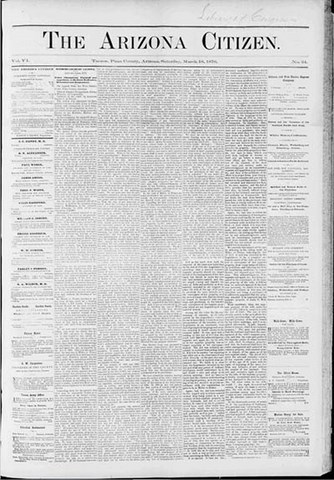
In his edition of March 18, 1876, the Arizona Citizen published the first and last pages of the appeal of my nephew Peter's appeal, saying that a woman once married can dispose freely of her property acquired before or after marriage.
Ci against the 1st page
These expectations will be a landmark in the US legislation on women's rights, and will serve as jurisprudence for future proceedings ....
I have, in some ways, promoted the rights of women at a time when they were considered subordinate, subjected to their husbands and deprived of their property rights ...
Opposite, the rest of the expected ...
.
Charles Austin Tweed
Charles Austin Tweed (December 24, 1813 to 1822 July, 1887) was an American politician and jurist. Early in his career, he was elected to the Senate of Florida and the Senate of the State of California. Tweed then moved to the Territory of Arizona and was appointed to serve two terms as Deputy Judge of the Supreme Court of Arizona Territorial