
Judge Edmund F. Dunne
Richard continues to claim my property ....
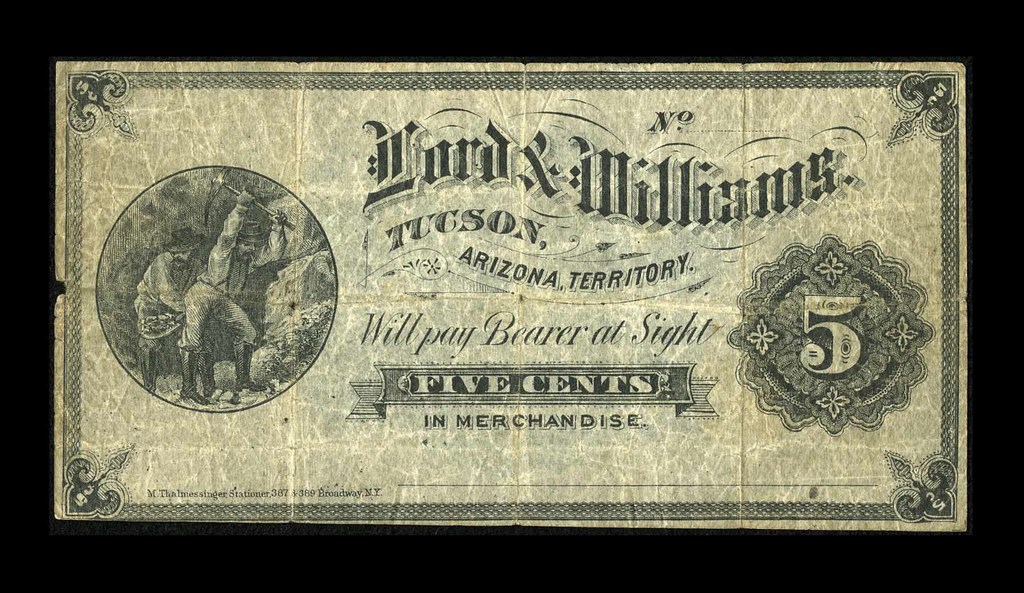
On April 8, 1875, I lent $ 3,000 ($ 47,103) to Charles Lord and W. Williams, owners of the mercantile Lord & Williams Company of Tucson, for three months; and 2000 $ (31411 €), within fifteen days.
The partners Charles H. Lord, M.D. and W.W. Williams were doing business in several areas, acting as brokers and as bankers. The end of the mining boom was the beginning of the disappearance of the company, in October 1881.
Opposite exchange bill issued by this company
At the beginning of May Richard had again sent a notice to some of my tenants who had to pay their rent only to Rigas Soto who had rented a house on Maiden Lane and Theodore Lopez and Dolores Perez, who lived on Convent Street. He also notified Lord and Williams, in two separate notes dated May 5, the repayment of their loans directly to him and not to myself .... If you do not do that, he warned, " I will hold you responsible. "
In May I sold the 11,000 pounds of grain (4,950 t) of Richard, from the harvest of September 1872, leaving part of the grain to Peter.
On May 8, the Citizen reported that I had once again harvested two hundred acres (81 ha) of cotton. "The plants to come will be fine and of uniform size, and will realize in the present perspective a good return," predicted the newspaper. On June 4, I indicated that I remained active in my companies and that I was solely responsible. I was referring to a provision of the Arizona law that was a reminder of the Spanish period, which allowed married women to do business under their own name and for their own benefit.
So Richard had no claim to make on my businesses or my property.
I also announced that I planned to invest approximately $ 5,000 (€ 78,534) in my "money lending, securities business, as well as purchases / sales and to maintain and improve my real estate leases
Judge Edmund F. Dunne in favor of Richard
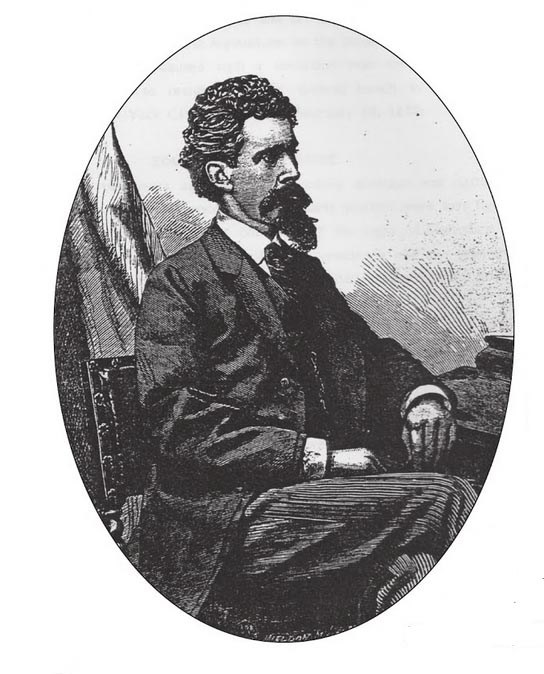
US Senator William Morris Stewart, on the advice of Governor Anson PK Safford, recommended Dunne to replace John Titus as Chief Justice of the Arizona Supreme Court. President Ulysses S. Grant appointed him on March 6, 1874, The new Chief Justice arrived with his family at the end of June and settled in Tucson. During his spare time, he traveled across the territory with Governor Safford and was credited with planting the first "orange orchard" of Arizona at the end of 1874.
The revocation of Dunne came for reasons other than his legal expertise. As an ardent Catholic, the chief judge believed that the church should manage all the education of the territory. He publicly expressed this belief in February 1875 in a speech to the 8th Arizona Territorial Legislative Assembly. He continued his efforts in newspaper columns, some of which drew attention to the East Coast. The appeals went so far as the possibility for Catholics to stop paying taxes that have funded public schools. Faced with this turmoil, President Grant decided to revoke Dunne in December 1875. The Chief Justice remained on the bench until the end of January1876 ...
After considerable delay, the Richard Woffenden case against Pedro Charoleau (sic), finally came to trial in the Tucson District Court on 2 July 1875.
Judge Edmund F. Dunne, who had replaced John Titus as a judge of the District Court and Supreme Court, ruled in favor of Richard, granting him ownership of the three ranches of the Gila River, with $ 109.60 (1940 €) for damages ..... Woffenden quickly took possession of it after recovering the key from the Robledo / Charouleau ranch.
That same month (July 1875) I deposited in the registry office of the county of Pima the act by which I had transferred my property, including the three ranches, to Peter.
On July 9, 1875, Pierre also filed a lawsuit in the District Court, (Pedro Charouleau v. Richard Woffenden Case 40) and sought restitution of the three ranches that the court had awarded to Woffenden on July 2.
Pierre against Richard
At the same time, Pierre stated that Woffenden had "seized for his own use" a 400,000-pound (180-tonne) wheat and barley crop valued at around $ 8,000 ($ 126,000) and apples of ground, beans, onions of peppers for $ 500 (7783 €). He claimed $ 10,000 ($ 157,455) in damages.
Woffenden replied on July 10th.
The case was dismissed on September 6, but Pierre re-filed his file that same day.
Based on the decision of July 2, Woffenden again prosecuted Pierre on July 15 (Richard Woffenden vs. Peter Charouleau Case 45), and now claimed damages for Pierre's seizure of the three ranches the previous year. He claimed $ 3600 (€ 56,600) for "loss of rent and profits", the restitution of "his properties", as well as $ 1,890 (€ 30,000) as a refund, and $ 300 (€ 4727 ) for "damages for the possession of such property.
Finally, he asked that the amount of damages be tripled. Just that !!!!
The act that Peter had recently deposed and the acts of John will not be examined for almost a year !!!!
In August, Woffenden filed a motion in the District Court to set aside Anna Charouleau's two-year injunction against him.
On August 13, 1873, he declared an "empty" agreement, and asserted that the injunction did not stand up.
Woffenden once again argued that during marriage, the spouses' property separation produced profits that became property of the community to which he should have access.
Dunne dissolves the injunction of August 13, 1873
Return to the court of Judge Dunne on 9 and 10 August.
I objected that the matter had already been well considered and a decision had been rendered, so there was no reason to reopen it.
Dunne quashed my objection, stating that "the order of injunction clause" was not established ... therefore, the impugned order that was made was not final, nor perpetual ".
I tried to introduce the evidence of the three of Richard's opinions to my tenants by demonstrating a violation of the injunction.
Judge Dunne rejected my evidence "on the grounds that they were not sufficient."
In the end, Dunne cancels the injunction.
He declared that the agreement of 13 August 1873 between us was "null and void", holding that the injunction violated the right of access of the husband and was "excessive and therefore illegal" !!!
It was also "useless", that I could have "a complete and lawful remedy for all the wrongs I have complained about.
On August 16, I appealed the Dunne decision to the Supreme Territorial Court.
On September 6, 1875, Pierre re-filed his July file (Pedro Charouleau against Richard Woffenden with a more complete description of the property he had lost when Woffenden took over the Gila River ranches.
Pierre again stated that he was losing $ 250 ($ 3,900) per month of rent and demanded a refund of the value of the rents, $ 10,000 ($ 157,356) in damages, and the return of the land.
My appeal to the Supreme Court
I appealed Dunne's decision to the Arizona Supreme Court of Justice. The trial took place on January 21, 1876, and the Supreme Court rendered its territorial judgment on the 26th.
In a two-to-one decision, the judges ruled that the lower court was wrong to dissolve the injunction, "because the same case had already been fully and definitively heard and decided".
No new evidence or document had changed the circumstances originally presented to the court in 1873. Consequently, the order to dissolve the injunction was "to be set aside".
Judge Dunne therefore stayed his decision.
It was a victory for me in establishing that married women could seek redress in the courts and that the financial control exercised by their husbands on their separate property and their own income could not be exercised.
The injunction was reinstated, but what about the property that remained to be protected?
This will depend on the outcome of the outstanding trials between Pierre and Richard Woffenden.
The removal of the judge ....
Of course, this was not to displease me, because this judge made extremely frustrating efforts against me and Pierre, dispossessing us of our properties in favor of Richard ...
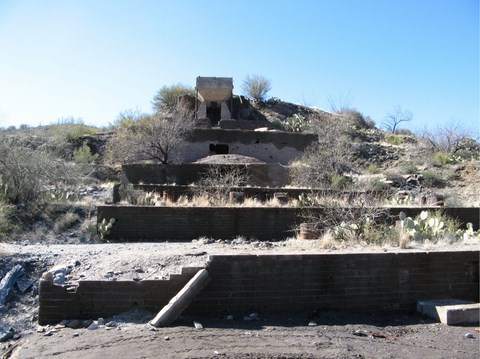
Dunne and Woffenden had a strong and friendly relationship. Prior to July, they had traveled together to inspect the mines in Pinal County, in which they had a common interest or sought to acquire one. (above, Remains of Ajax Mines County of Pinal)
The petition accused Dunne of "an irresistible propensity to enlist as a partisan in every ongoing religious, political, and personal controversy." We have argued that Dunne, who favored parochial education, made derogatory comments about the system of the Arizona Public School.The opinions of Dunne have been heavily criticized many times in the territory and have even created some controversy outside of Arizona especially on the east coast.
Still others have complained that he appeared so "partial in his decisions and decisions, that we have lost all confidence in him as a judge."
The Pima Supervisory Board and the Tucson Municipal Council sent petitions calling for its withdrawal, as did a group of prominent lawyers and county officials.
President Ulysses S. Grant eventually withdrew to Dunne his two positions in January 1876.
Not dissatisfied at all with having actively participated in the dismissal of this judge ......