Richard an uncommon litigator
Le White Ranch
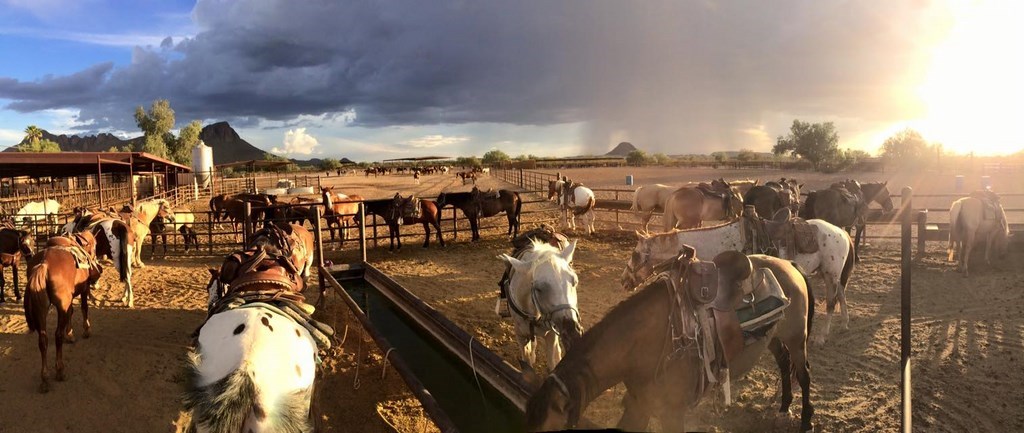
Prior to Peter's arrival, Richard went to the ranches of the Gila River on January 2, 1874, taking with him a pair of mules, a pair of horses, three teams, and other things necessary for agriculture and planting.
He worked on what he considered to be his own ranch.
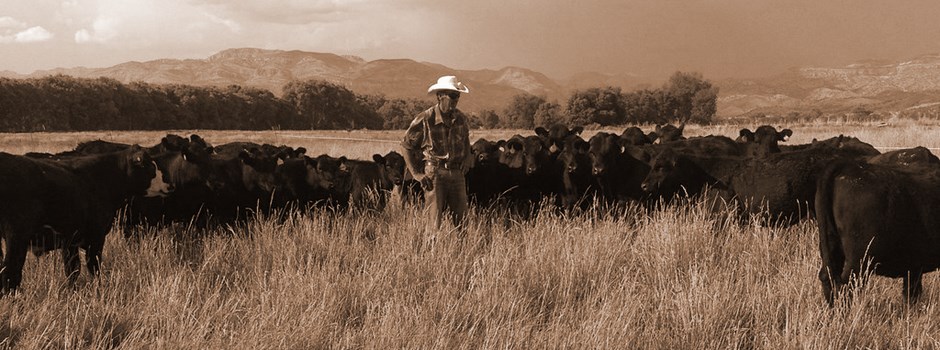
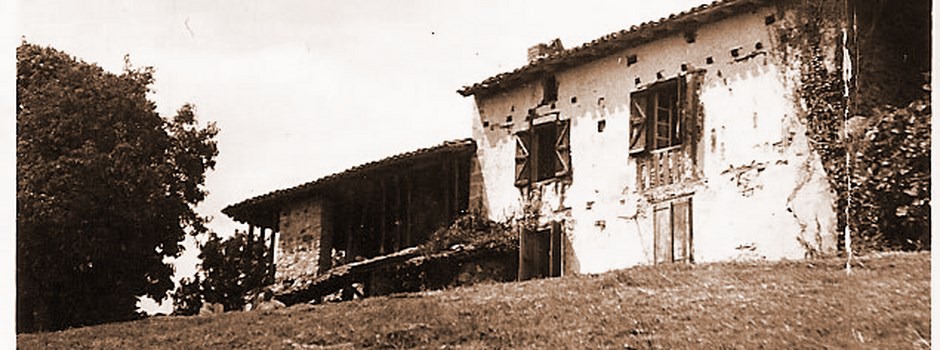
Although he does not personally own land in the area, he was referring to Jose Arviso's ranch, originally known as White Ranch. (Photo above: The White Ranch now become the White Stallion Ranch, one of the most famous tourist stages ...)
By promoting his marital rights, he had included some of the fields of the Robledo, Moreno, and Duran ranches that I owned, and had begun to sow wheat and barley on two hundred acres. What I found with my nephew on January 19th.
The next day I showed my nephew all my possessions, an opportunity for him to familiarize himself with my lands.
Adamsville or Sanford
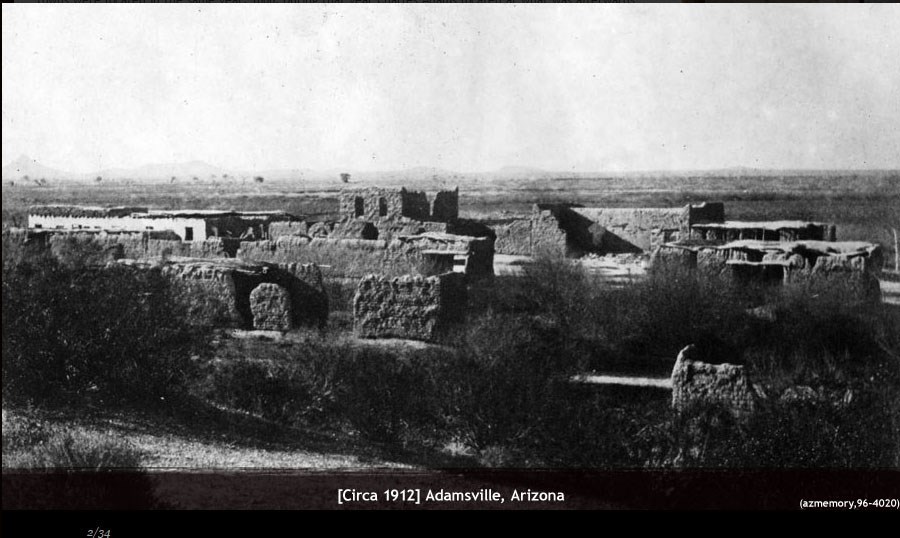
(1 section has an area of 640 acres, or 2.58 km², Pierre bought 5/4, or 3.22 km²)
Pierre moved to the Robledo Ranch and returned to Tucson.
Pierre and Richard worked the land, with the help of a team of men headquartered on the Robledo Ranch.
After three or four weeks, a man called James Keenan came to fetch Pierre and asked him to work as an accountant.
Irritated by Woffenden's refusal to allow Keenan to work, Pierre and Keenan left the Robledo house to avoid any discussion.
They settled in Adamsville, to work from there for about six weeks.
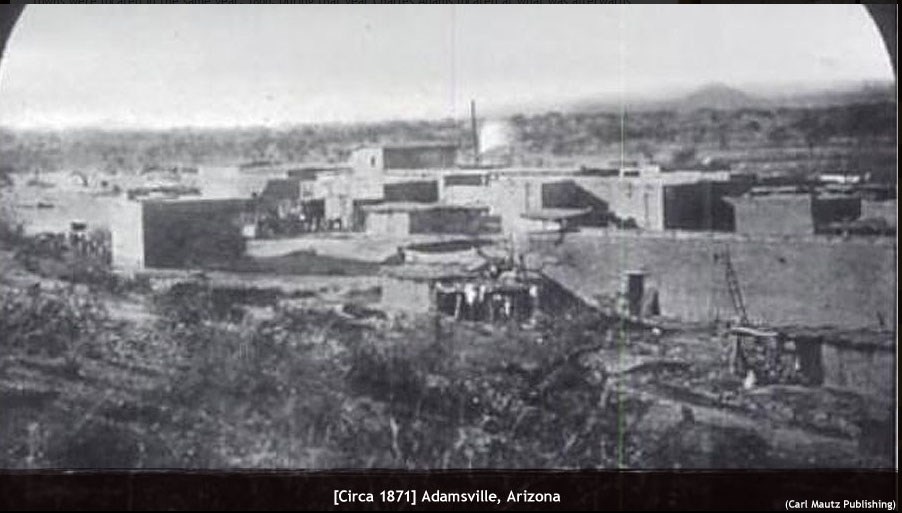
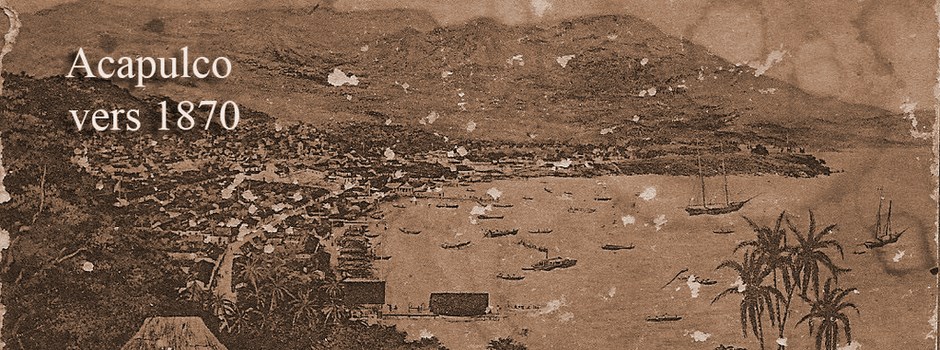
Adamsville (pictured above and opposite) was one of the first two cities created in Pinal County, Arizona.
She was named for her original settler in 1866, Charles S. Adams. When a post office was established in 1871, it was named Sanford, (in reference to Captain George B. Sanford of the First US Cavalry), by a political enemy of Mr. Adams, Richard McCormick. There was a flour mill and water tanks.
On July 4, 1871, for the first time, flour was produced. The life of this mill was short, on September 2, 1871, the mill was burnt. There was a suspicion of arson and the loss was estimated at $ 10,000 ($ 158,105).
William Bichard continued to sell flour produced at the Adamsville Mill in a small store in Phoenix, until September 7, 1868, when the Gila River whipped out during a great flood.
Pierre VS Richard

On April 10th, Pierre forced the door lock to enter the house. Then, in the middle of the month, he took two horses and three pairs of oxen from the estate where the men of Woffenden were working.
This led to the first conflict, following a series of more or less legal maneuvers between the two men.
In Florence, on 27 April, Woffenden filed an action against Peter in the court of justice of the peace Levi Ruggles for the theft of a horse and a pair of oxen.
Ruggles ruled in favor of Peter when Peter proved he had bought me these animals.
Then, on the 14th of May, in the same court, Pierre Charouleau lodged a complaint against Woffenden for a horse, two pairs of oxen, and two sets of harness.
Ruggles again ruled in favor of Peter, for the same reason.
On September 9, Woffenden appealed the decision to the Tucson District Court, which issued an order the same day.
Florence, founded in 1866 by Levi Ruggles, an Indian agent. It brought together land and created the site of the town south of the Gila River, where the Indians had cultivated for centuries and where Mexicans began to establish farms as early as the 1850s. In Photo, the Court of Justice .
A problematic harvest
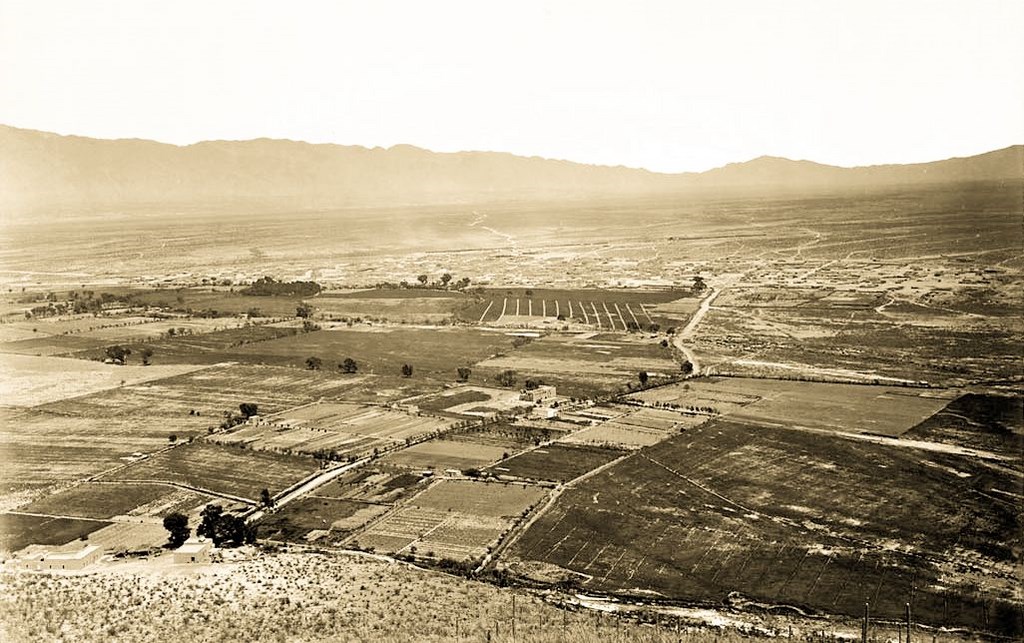
Woffenden left the Gila River for Tucson in early May. His intention, he said later, was to return to the ranches in September with bags for grain harvest after pounding.
At the beginning of July Peter sent word to Woffenden that he would have to supply ten men to harvest his half harvest.
The harvest began on 12 July and lasted until 10 August.
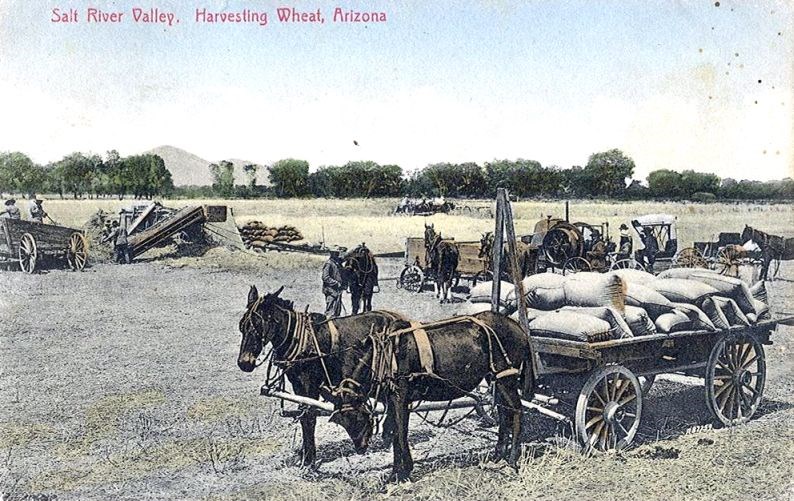
Above culture landscapes around Tucson circa 1870
Sixty thousand pounds of wheat and barley (27 tons) and 200,000 pounds (90 tons) were cut and stacked in the fields.
On August 21 Woffenden filed a complaint against Pierre, alleging that Pierre had entered and detained by force the three ranches he considered his property, and that he sought to recover them. He forgets, however, that I had sold these ranches to my nephew.
He also demanded that Pierre could not take the entire crop, accusing him of taking 1,200 pounds (540 Kg) and threatening to take the equivalent of half the crop without his consent. To do so, he asked for a fine of $ 24 (€ 380) to cover the loss until the final resolution of this action.
Nearly a year will pass before the trial.
The threshing took place between 7 and 10 September 1874. Although he was informed that the threshing machine was available, Woffenden did not respond, did not arrive until the 10th.
Pierre, meanwhile, had separated the beaten grain in "an equal number of quintals."
Upon his arrival at the Robledo Ranch, Woffenden ordered Peter to take the grain from Adamsville and Florence, where he might be sold; sharing the benefit.
Pierre replied that he intended to keep his harvest half at the Robledo Ranch. Woffenden, was thus free to do as he pleased for his part. He would find in the field what he wished to collect. Richard will not reap anything by stating that he was gone because Peter said he had stolen it four times and would "treat" him if he stayed there.
He never collected his share of the grain, abandoning his harvest leaving it to the inclement weather. When Rafael Tapia announced in October that he was ready to burn the fields to prepare them for the next seeding campaign, I instructed Pierre to take what was left of the crop placed in the Robledo Ranch.
Jean Charouleau

He will become a celebrity of Tucson and will generally be known as Juan, and sometimes as JP, (Jean Pierre) on legal documents.
On 25 June 1875, I sold to John eleven lots in the city for $ 2,500 (39,268 €).
In a second act on the same date, I sold him two properties, and another plot, near the Gila river (photo opposite), for a total of $ 1500 (26,250 €).
In September, I sold him more than a quarter of a section (over 64.73) ha in the same area for $ 300 (€ 5,310).
This was the last of my properties.
A number of years will pass before John is inevitably entangled in the dispute between Peter and Richard Woffenden.