My life in Tucson AZ
The Young American Club
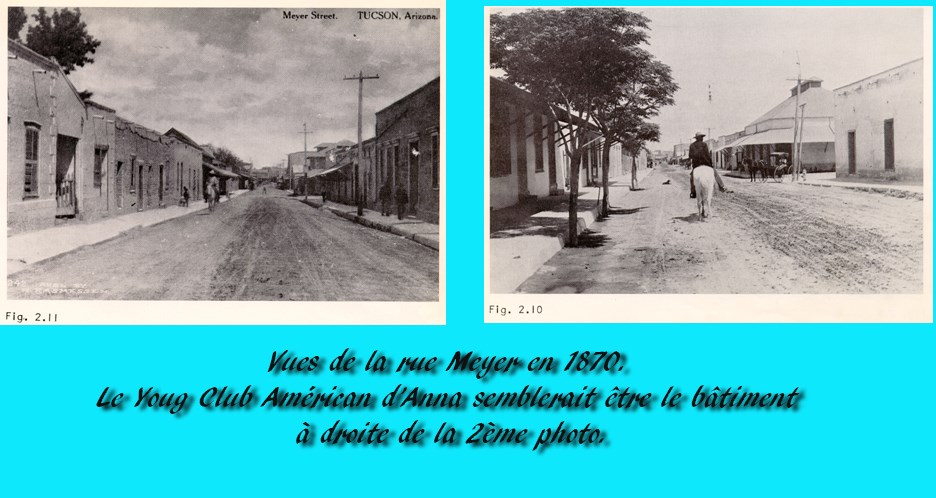
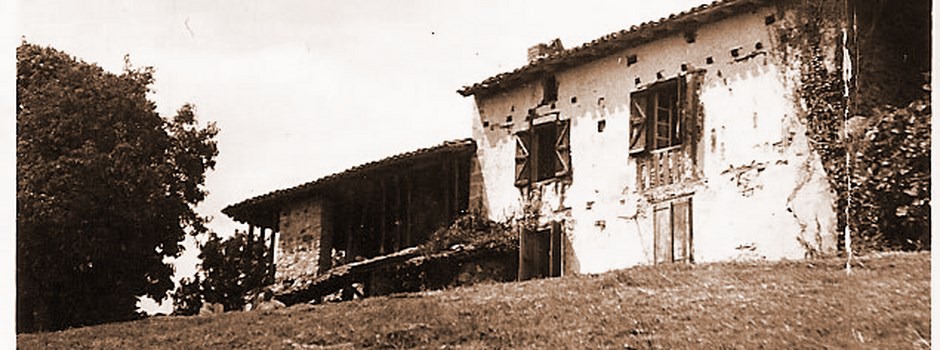
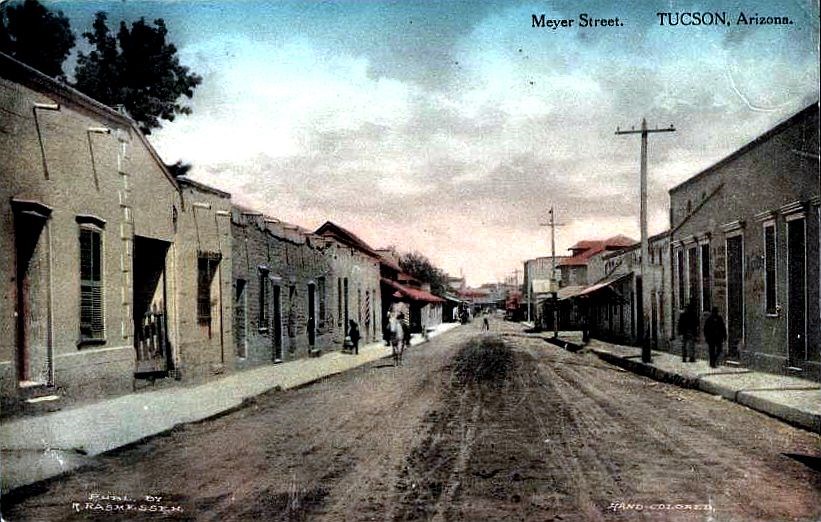
In the spring of 1871, I built a two-storey building on my property at the southeast corner of Meyer and Mesilla (pictured above) on a lot I bought in December 1870.
The second floor was made of bricks (adobes), a building material widely spread at the time.
On July 15th, the Young American Club (Youth House) is opened in a "new and spacious building".
It quickly became a popular place for dances and private parties, but the young people of that time were not respectful of their environment.
On October 12, a grand jury accused me of public nuisance due to the "dirty, harmful and olfactory condition" caused by the Young American Club and extended to other buildings on the block.
The indictment stated that "the various smells and foul odors were so pernicious and unhealthy ... that they made the air in the neighborhood around it and at a great distance, thus greatly filled and impregnated with infectious, offensive and unhealthy odors, and stinks, has been corrupted and rendered very unhealthy, and has caused much damage and public nuisance to the neighborhood and the people who pass along the said street.
I pleaded not guilty on October 16, and I assured court on the 19th that I had corrected the problem and asked to change my plea of not guilty.
The court fined me $ 50. (Current 780 €)
In July 1872, I closed the Young American Club and I created a shop with the sign Ed Wood & Co, occupying the space of my building the n ° 6.
Maiden Lane, "The red-light district"
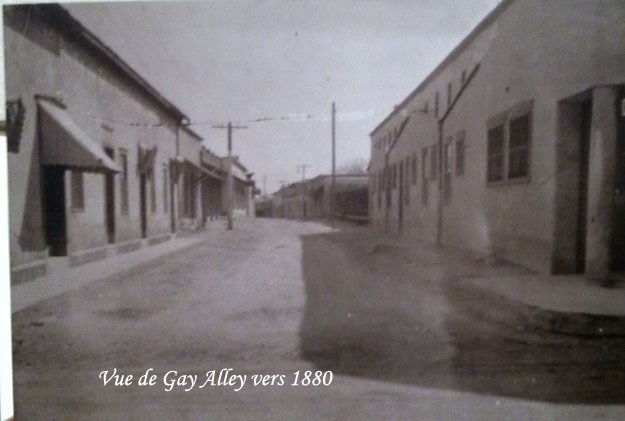
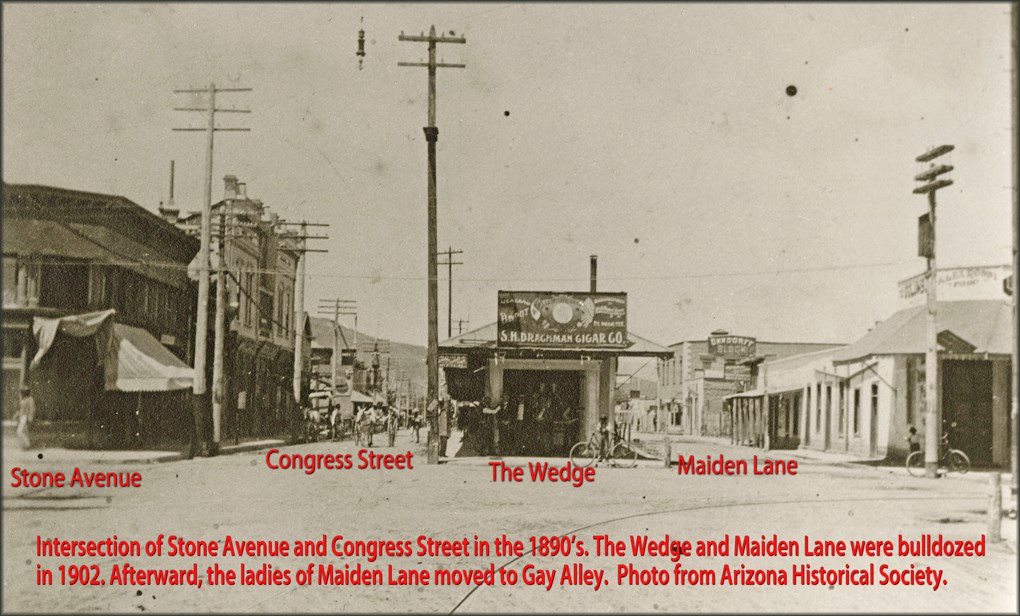


It has been suggested that I will have amassed my fortune by my work as "Madame", namely tenancière of the local brothel, located on Gay Alley ....
Indeed, three of my town lots were on the street corners that crossed Maiden Lane (now Gay Alley) the "hot" neighborhood of Tucson.
Gay Alley did not exist as a street. But for 30 years, the two dusty blocks, along an unpaved street (named after the pioneer Mervin Gay) were the center of a "hot" and lively district. Most of these settlements were in the corner of a narrow strip of land south of the ancient Presidio, between Congress Street and Calle de la Triste India (later renamed "Maiden Lane").
The activity of the day was prostitution. It was legal and functioning, with 250 women working there. In 1917 prostitution became illegal.
There is no evidence to suggest that I was able to take an active part in the management of some brothels, chambers, or saloons, which may have been exploited on my properties. I had a much more lucrative interest in my business: running a store, lending money, taking mortgages, renting buildings, collecting farm incomes ....
My Maiden Lane properties have been just a source of rental income ..
Cotton growing
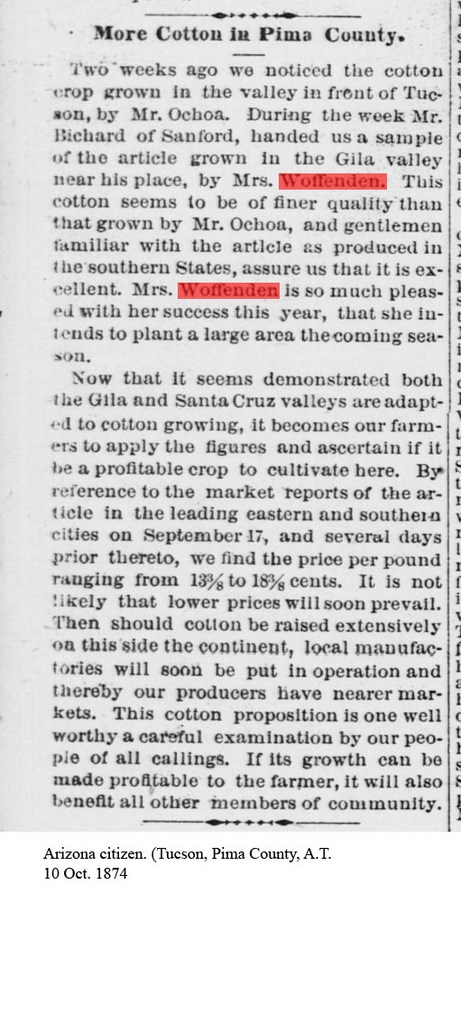
In October 1874, Stephen Bichard, a merchant and miller from Sanford, Arizona, brought a specimen of cotton from the Gila River Valley to the Arizona publisher at Tucson Citizen.
The newspaper recently praised cotton cultivated by Mr. Ochoa along the Santa Cruz River. The paper argued that the Gila River cotton was "finer in quality" than Ochoa, and comparable to that of South America ...

In fact, the producer of the Gila River was Mrs. Woffenden, that is to say myself, because in the meantime I had married Richard Woffenden ...
I was so satisfied with this plantation and its quality that I decided to plant a large area for the coming season. Thus, the Gila River and Santa Cruz valleys have become suitable for cotton growing.
Today, at the beginning of the 21st century, and partly thanks to me, 200,000 acres (or 810 km²) are cotton crops and this production represents a significant part of Arizona's agriculture.
My social life in Tucson

I was the godmother of my little niece Anna Serafina, daughter of my nephew Pierre, in 1876. Unfortunately, she died with her mother Serafine a few days later.
I was also the godmother of Maria Louise Brown. She was the daughter of Charles O. Brown from the west. Legend has it that he was a member of the Glanton group that scalped Native Americans in Chihuahua, Mexico, a group that received $ 150 per scalp. After Glanton and other members of the group were murdered by Amerindians around Yuma, Arizona, Brown went to California to return to Arizona around 1858.
Brown was a resident of Tucson. He was awarded a monopoly on the sale of alcoholic beverages and gambling in Tucson by Colonel West.
He met his wife in the Mesilla Valley, a daughter of a good Mexican family. They returned to Tucson to reside there permanently around 1864 or 1865. It flourished in its activity of saloon which became a popular place for all citizens.
Around 1867 or 1868, he built the congress saloon in Tucson. The living room had wooden floors, the wood coming from Santa Fe. It was for years the best saloons in southern Arizona.
Though owner of a thriving saloon, the money was spent as fast as it was earned. He was generous to his friends and he wasted all his fortune.
I was also the godmother of Ana Mendibles. His father Agapito and his mother Lorette were Mexican and were part of the Pioneers of Tucson.
Lire la suite